
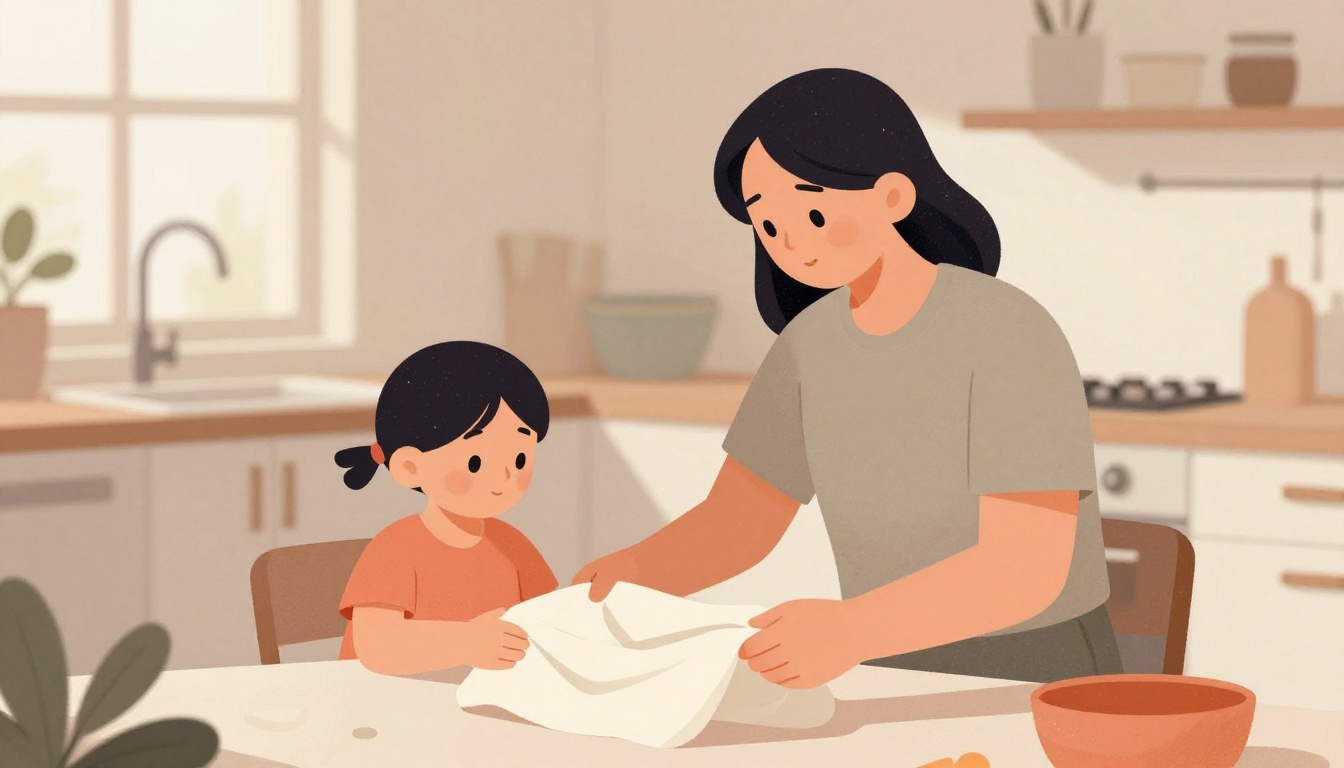
If your child is working on speech and language skills, you may feel pressure to squeeze in extra practice on top of an already full day. The good news: you do not need flashcards, apps, or a separate block of time. The routines you already run — laundry, dishes, meals, tidying — are packed with natural language opportunities, and speech-language pathologists routinely recommend using them.
According to the American Academy of Child and Adolescent Psychiatry, which of these is an appropriate chore for a 4- to 5-year-old?
Select one answer.
Why chores work as speech practice
Chores are predictable, they repeat daily or weekly, and they involve real objects and actions. That combination gives a child repeated exposure to the same words in the same context, which is how vocabulary and comprehension grow. Repetition also builds the predictable patterns that help children who need structure, including children on the autism spectrum, practice life skills and language together (Blossom Children's Center).
Chores also carry hidden academic and motor benefits. Sorting laundry by color or grouping forks and spoons builds classification skills, while wiping a counter or folding clothes works fine motor and coordination skills (PBS KIDS for Parents). You are not choosing between speech practice and getting the house in order — you are doing both.
Match the chore to your child's age
Pick tasks your child can actually succeed at. The American Academy of Child and Adolescent Psychiatry suggests that 2- to 3-year-olds can put toys and groceries away and dress themselves with help, while 4- to 5-year-olds can help feed pets, make their beds, and help clear the table after dinner (AACAP).
- Toddlers (2–3): put toys in a bin, carry laundry to the basket, put groceries on a low shelf.
- Preschoolers (3–5): set the table, feed the pet, wipe the table, sort laundry by color.
- Early elementary (6–7): put laundry away, sweep, wipe counters.
Four strategies to use during any chore
1. Narrate what you are doing
Talk through the steps out loud: "First we brush teeth, then we comb hair, then we eat breakfast." This builds sequencing and vocabulary without any extra materials (Milestones Matter Therapy). During chores it sounds like: "Now I'm cutting the apple. The apple is red."
2. Offer choices instead of yes/no questions
"Do you want the red shirt or the blue shirt?" gives your child a real reason to communicate and builds decision-making. The same move works at the laundry basket: "Socks or shirts first?"
3. Model words, don't correct them
If your child says "wabbit," respond with "Yes, that's a rabbit!" — emphasis, not correction. Modeling correct speech keeps the interaction positive and still gives your child the accurate version to hear.
4. Wait, and let them fill the gap
Resist finishing your child's sentences. Pause after you model a word or ask a question and give them time to respond. Waiting is one of the simplest and most effective things you can do.
A quick chore-time checklist
- Pick one chore you already do daily — do not add a new one.
- Choose two or three target words for that chore ("on," "in," "open," "more").
- Narrate your actions in short phrases.
- Offer a choice at least once.
- Model the correct word instead of correcting.
- Pause and wait for a response.
- Praise the attempt, not just the finished task.
When to bring in a professional
Home practice supplements therapy — it does not replace it. If your child is not meeting communication milestones, if you are unsure which words or sounds to target, or if home practice is not moving the needle, an evaluation with a speech-language pathologist can tell you exactly what to work on and how. Always follow your SLP's specific recommendations for your child rather than a general list.
How the Featured Expert Can Help
Domino Therapy offers speech therapy services for families, schools, and therapists, with both in-person and virtual support. Based in Philadelphia, PA, the practice focuses on enhancing communication skills and professional growth. You can learn more at domino therapies.
Test your understanding
Before you try this at home, check one key fact about how chores support communication.